2009 Ramble Plant Sale


Beginning on Friday November 20 and through Sunday November 22, the best plant sale of the year will take place at the 69th Annual Ramble.  Among the wide variety of plants for sale, there will be these special ones grown in Fairchild's own nursery.  Included in the sale will be:


Pimenta racemosa, the lemon-scented bay rum tree, is closely related to allspice. It is a small to medium sized tree native to Jamaica. The evergreen leaves, when crushed, emit a wonderful, lemon-bay rum scent.  An oil is distilled from the leaves to make perfumes and colognes.  The trunk and main branches have exfoliating bark which exposes lighter-hued inner bark. White flowers are followed by black oblong berries. This species may be grown in full sun to light shade.


Coccothrinax crinita, native to Cuba, is one of the most beautiful and unique palms.  Known as old man palm due to the long greyish fibers which cover the trunk, it grows slowly but is well suited to our limestone soils, hot sun and dry winters.  Old man palm seldom grows more than 15’ tall.  The rich green palmate leaves form a beautiful crown. A soft breeze which shows the silvery undersides of the large fronds shining in the sunlight just adds to the beauty of this palm.


 One of our 2008 Fairchild Plants of the Year, Myrcianthes fragrans, Simpson's stopper, is a native of hammocks of south Florida and tropical America.  This shrub or small tree grows to 20 feet tall. It makes a great hedge and is a low maintenance alternative to the commonly used ficus hedge.  Simpson's stopper's silvery gray to warm brown bark naturally peels to reveal a smooth burnished copper colored inner layer.  Crush the small, slightly leathery leaves and you will discover a pleasant aroma.  Fragrant little white flowers are produced intermittently through the spring and summer.  Showy red-orange fruit provide food for several bird species.  Simpson's stopper will have a dense branching habit if grown in full sun.  When grown in shade, the foliage is less dense and the trunk displays its attractive, smooth, exfoliating bark.  Plant one near a feeder or bird bath for shy birds such as painted buntings and cardinals to use as a safe haven.


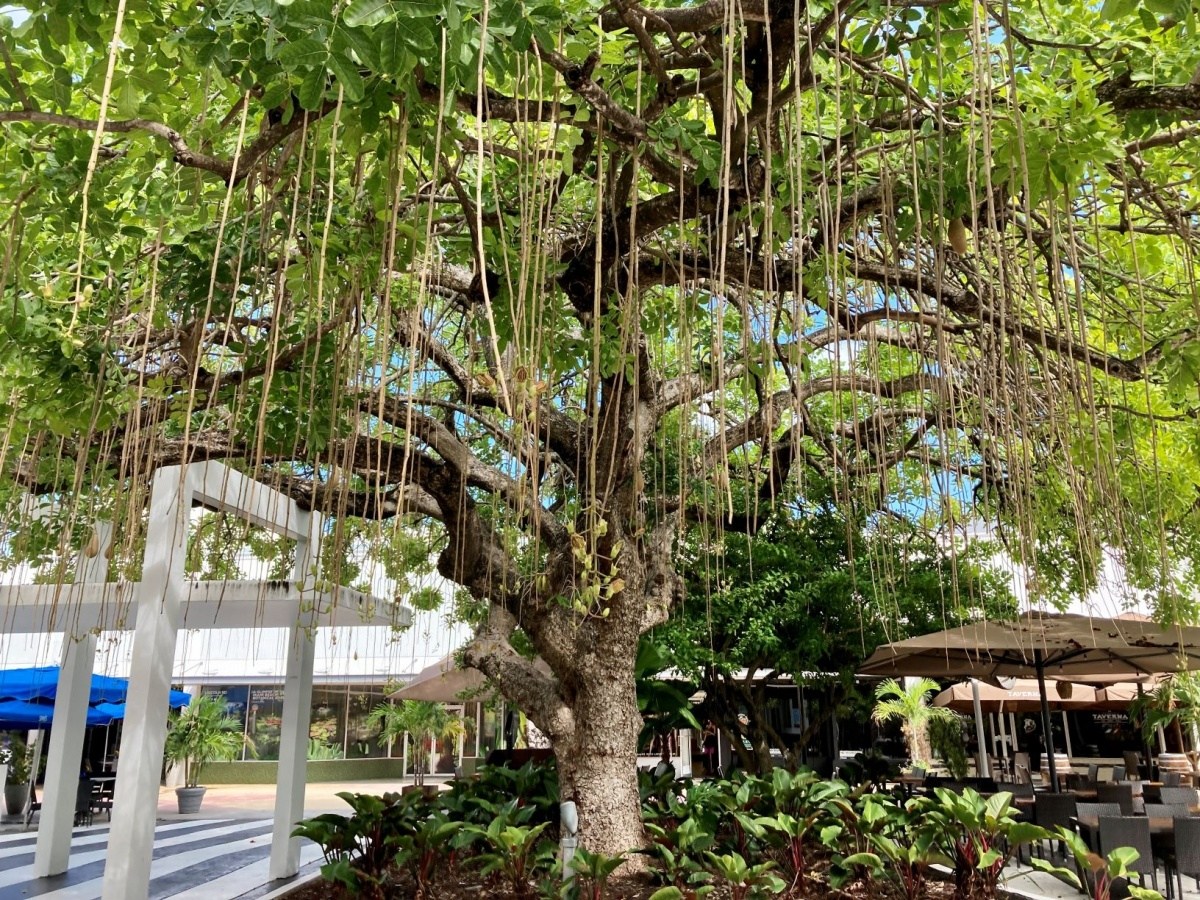
Caesalpinia granadillo, sometimes called bridalveil tree, is native to Venezuela.  Not commonly available in nurseries, bridalveil tree may increase in popularity once people discover its outstanding characteristics. The fine-textured foliage combines with an upright-vase shape to form a canopy tree to 35’ tall with few equals. Yellow flowers appear during summer and fall. The trunks are very showy with bark peeling off in thin strips to reveal an interesting green and grey mottling.  Bridalveil tree is well suited for a residence, staying small enough to keep it from overtaking a property. It can be planted along a road or placed in a parking lot to create a nice canopy of soft foliage.  Bridalveil tree should be grown in full sun on well-drained soil. The tree is moderately drought tolerant.   (May be seen adjacent to the Visitors Center.)


Stemmadenia litoralis, the Milky-way tree, is a perfect small tree for Florida landscapes.  This was selected as the 2009 Fairchild Plant of the Year.  Left to branch naturally, it will create a pleasing shape and produce flowers on every branch.  The finely textured, light colored bark is an attractive contrast to the deep green leaves.  The incredibly fragrant flowers begin to appear in late winter or early spring and continue through the summer into the fall.  Each linen-white flower has five petals formed in a pinwheel fashion, overlapping in a counter-clockwise direction. The pale yellow throat draws the eye to the heart of this whirl where a star is formed by the joining of the petals.  A delicate fragrance surrounds the area near the tree, evoking early-morning freshness. The Milky-way tree is native to Mexico to northern Colombia.   Not fussy about water or sun, it can be grown in filtered light or full shade and needs no irrigation once established. 


Rarely Offered for Sale!
Vallesia antillana, pearlberry, is a dense shrub reaching eight feet tall at maturity. It is native to the Florida Keys, Cuba, Jamaica, and Hispaniola. Considered endangered in Florida, this enchanting shrub produces white flowers that appear like small stars among the lush, dark green leaves. Elegant pearl-like fruits are produced throughout the warm months. Pearlberry is best grown in light shade. It is salt tolerant.  Landscaping hint: It is just the right size for hiding an outdoor air conditioning unit. 


 Tetrazygia bicolor, one of our most ornamental native shrubs, may be seen in pinelands or persisting in hammocks as a small tree. Distinctive leaves have three to five longitudinal ribs. Young leaves are pink.  Butterflies visit the showy white flowers which are produced in large terminal racemes during the summer, followed by black fruits in the late fall. Butterflies visit the flowers. The fruits are much sought after by birds. It may be grown in full sun to light shade. It is best grown in an area without supplemental irrigation.  It does not tolerate pruning.


Atala butterfly nectaring on Cordia globosa  


Cordia globosa, butterfly sage, is a shrub to small tree native to south Florida.  The small cup-shaped white flowers attract numerous butterflies, including Gulf frittalary, Atala, hairstreaks, ruddy daggerwing, and skippers and other insects as well.  With so much insect activity, birds, including warblers, come to feed on the insects.  Fruit-eating birds are attracted to the small, bright red fruit.  The butterfly sage is a wildlife magnet!  Grow in full sun to light shade.


Bourreria cassinifolia, smooth strongback, is a Florida endangered species native to a few pinelands of south Florida and the Florida Keys.  Strongback is a shrub to 8 feet tall and about 6 feet wide.   Small leaves, small white flowers and bright orange fruit attract butterflies to the flowers and birds to the fruit.  The fragrance of the flowers is a wonderful, fresh, light but oh so nice perfume.  If there was such a thing as smooth strongback eau de cologne, I would be in line to buy a bottle!  This shrub prefers a sunny location and does not require irrigation once established.


 Schippia concolor, silver pimento palm, is an elegant, small species native to both the open, dry pinelands and moist forests of Belize. The slender trunk has an open crown of deeply divided two-foot palmate leaves with leafstems two to six feet long. Showy, white inflorescences are followed by clusters of white fruit one-inch in diameter. This dainty palm may be grown in full sun to light shade.


In addition to the plants grown by Fairchild there will be thousands of plants available which were grown by members of the local plant societies listed below:

The Florida Caribbean Chapter of the American Bamboo Society
American Bougainvillea Society
Bromeliad Society of South Florida
South Florida Cactus and Succulent Society
Tropical Fern and Exotic Plant Society
Tropical Flowering Tree Society
Rare Fruit Council International   
Gifford Arboretum
Heliconia Society of South Florida   
Dade County Chapter Florida Native Plant Society
Orchid Society of Coral Gables
South Florida Palm Society