Garden stories can arise from a single plant or a profusion of them, from a spectacular bird or glorious butterfly that visits a worthy bloom, or a new discovery made in the field that expands our understanding of the Earth. Any and all of these realms are for sharing and discussing on this blog, which we invite you to join.
Text and photos by Georgia Tasker
|
|
| The lotus seed pod 34 days after the flower opened. |
Comment - (0 comments)
![]() |
| Snail damage on a bromeliad. |
All the rain has been wonderful for plant growth and for providing a measure of relief from the heat, but it also brings out the snails. Take a walk through your garden early in the early morning and look for them. They will eat away the soft tissue of bromeliads, amaryllis, crinum lilies, and aroids.
Snails also may infest your orchid collection, so examine your potted orchids and even those in wooden baskets. Baskets may appear to have tiny bumps on them, but look closely and you may find that those are baby snails. Rub them off or soak the basket in a bucket of soapy water for a few minutes.
Collect snails in a jar of soapy water or in a plastic bag and discard them. It's best to make a few snail patrols at night or dawn.
A saucer of beer nudged into the ground at soil level will lure in snails and kill them overnight. Or, a 2-x-4 at the edge of the garden, positioned barely above ground, may collect a few on the bottom overnight.
Aphids also are busy when rains stimulate new growth. Watch for curling and distorted new leaves. Wait for the lady bugs to arrive or use a strong stream of water from the hose to wash them from their feeding outposts. Because the new growth is so tender, cup one hand about the leaves while spraying the hose to help protect the foliage.
Comment - (0 comments)
![]() |
| Atala butterfly. |
The atala butterflies are back, showing off their exquisite colors. Not only are the butterflies themselves lovely, the caterpillars also are vivid red with yellow dots. The butterfly garden is full of life now and worth a visit. Just sit on a bench for a few minutes and watch. You will feel yourself relax.
![]() |
| Larvae munch on a cyad. |
Atala butterfly larvae are readily spotted on the little Florida cycad, Zamia integrifolia from which they acquire a toxin. Their brilliant coloration is thought to warn predators to stay away.
Comment - (0 comments)
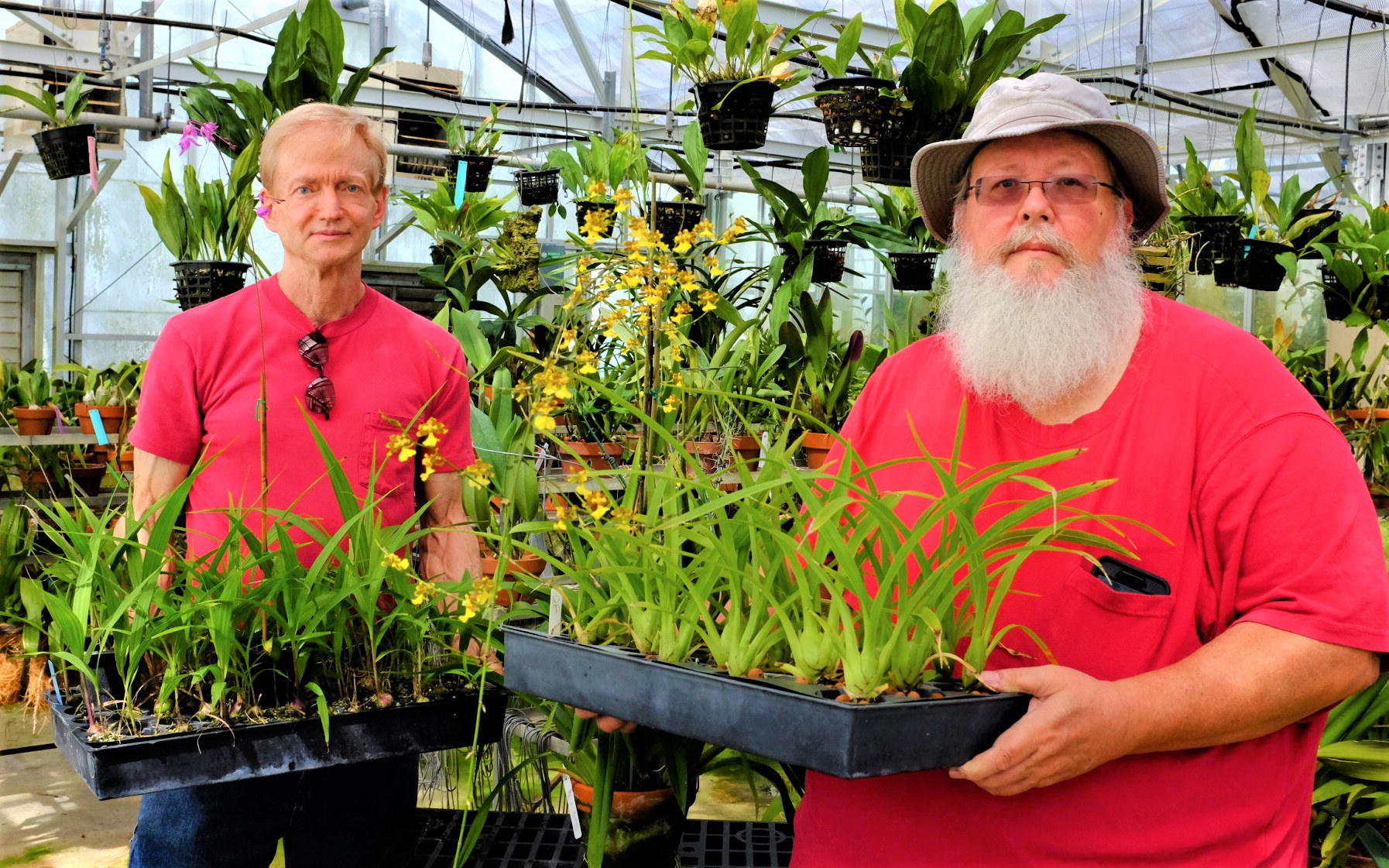
Tom Mirenda is the orchid collection specialist at the Smithsonian Institution in Washington, D.C. He was a speaker for the annual orchid symposium put on by the Coalition for Orchid Species last Sunday in the Garden House. He brought humor and fun to his talk about orchid pollination that capped a day of terrific presentations to the 70 or so people who attended.
Orchids are sly creatures when it comes to attracting pollinators, and they employ all kinds of tricks, from mimicking other plants to faking rewards for butterflies.
![]() |
| Is this a swarm of rival bees or a big specimen of Oncidium sphacelatum? |
One of the orchids widely grown in South Florida is Oncidium sphacelatum, which can become a huge plant with hundreds of small yellow flowers.
From a distance, Mirenda said, this mass of flowers appears to a macho bee to be a swarm of rival bees. So, the tricked bee hurls itself at the swarm, trying to drive them away. The outcome? Pollination.
Overall, oncidium flowers mimic flowers in the malpighia family (Malpighiaceae). One of our natives, Byrsonima lucida, is the larval host plant for Horace’s Duskywing, a small brown butterfly. It is called locust berry and has “clawed” petals and oil-filled glands below them. Female bees collecting oil to feed their brood visit these flowers. A different kind of bee visits the stigmas to collect pollen. In other words, the flower rewards the bees for visiting, and is pollinated at the same time. Many of the species in the family have flowers with oil rewards.
The shape of the sepals and petals of oncidiums resembles malpighia flowers so well that bees are fooled into visiting them, hunting for oil. They don’t find any, but they get the pollination job done.
Orchids, Mirenda said, take advantage of insect behavior and develop strategies to fit that behavior. Many flowering plants offer rewards for pollinators, including nectar, pollen, floral fragrance, resins and oils. Many orchids have evolved to imitate some of these without going to the trouble of producing nectar, fragrance resins or oils.
Epidendrums look a little like milkweeds, which lure their butterfly pollinators with copious amounts of nectar. Butterflies will search these orchid flowers, looking for their reward, only to be deceived. But the orchid benefits by being pollinated.
Mirenda pointed out that one of our native orchids, Calapogon tuberosa, has a flower with the lip pointing up. Just near the top of the lip are little yellow structures resembling short, wiry hairs. “Bees climb the column to get what appears to be pollen, the lip folds over, and the flower is pollinated.”
![]() |
| Psychopsis papilio: what pollinates it? No one knows. |
There are any number of deceitful practices orchids have evolved. Bulbophyllums and slipper orchids imitate a brood site for flies. Coryanthes orchids trap insects by dripping what appears to be nectar into a structure shaped like a bucket. The only escape is a narrow passage that requires the insect to squeeze by the pollen site and carry pollinia to the next flower.
Bee orchids, in the genus Ophrys, imitate female bees so convincingly that male bees try to mate with them. Lepanthes glicenstenii is an orchid with a structure that imitates female fungus gnats.
For all the weird and wonderful things known about orchid pollination, there still are mysteries to solve, he said. Termites might pollinate the underground orchid in Australia, Rhizanthella gardneri. No one knows for sure. Nor has anyone ever seen what pollinates Psychopsis papilio , the big yellow and brown orchid that looks like a butterfly.
Gongora tricolor produces a sex pheromone that attracts bees. How on earth did it evolve to do that?
Stay tuned. Orchid research is going on constantly.
Comment - (0 comments)
Little wonder the lotus is a sacred flower in parts of the world. The Bali Red that opened at home yesterday is exquisitely proportioned and delicately colored. We acquired seeds from a gardening friend, and followed his instructions.
![]() |
| Bali Red on its first open day. |
Seeds were scarified with a metal nail file and soaked in water for days in the kitchen window until the first leaf began to emerge. They were tenderly planted in aquatic soil mix but not put in the pond. Instead, we have them growing in large ceramic bowls. All last year, the tubers grew and sent up marvelous round leaves. Over winter, the leaf size shrank back but the plants didn’t die during all that cold. All along, they were given aquatic fertilizer tabs.
Now, the first flower has made the long wait worthwhile, blooming as predicted in its second year. And not only is it lovely, it is biologically interesting as well: the flower heats up to attract its beetle pollinators.
The first day, nine stigmas showed that they were receptive by glistening as the petals opened. By
![]() |
| Glistening yellow dots are receptive stigmas seen as the flower opens. |
early afternoon, the flower closed. In nature, this closure traps beetles inside, where they warm up and mate. This morning, on the second day, the petals opened more broadly, showing the pollen being released by the stamens. Should beetles have been inside, they would have emerged covered in pollen to carry to the next hot flower.
There are other flowers that heat up to attract pollinators. Cycads heat their cones and release sweet beetle-attracting scents. Plants in the aroid family, such as Philodendron selloum, heat their spathe when the female flowers on the spadix are receptive to pollination. Ditto magnolias, water lilies, aristolochias, some palms and members of the Panama hat plant family.
In 1997, Roger Seymour and Paul Schultze-Motel from the University of Adelaide wrote a paper on heat-generating flowers, saying that these ancient plants co-evolved with beetles, which need a good deal of heat and energy to fly. So the pollinators are lured into the large flower, are rewarded with warmth for their own mating, then fly off to pollinate the next flower.
![]() |
| On day two, the pollen is being shed onto petals below. |
Comment - (0 comments)
Maypop, Passiflora incarnata, is passion vine with lovely purple flowers. It has been a great
![]() |
| Fancy legs on this leaf-footed bug. |
draw at home for Gulf fritillaries, even though it has developed strategies that try to discourage butterflies from laying their
![]() |
| Nectar glands on calyx of a passion flower. |
eggs on the leaves. Its flower buds have nectaries on the edges of the calyces that draw ants, presumably to attack butterfly larvae. In addition to the ants, the plant tries to discourage butterfly egg-laying by producing glands on the leaf stems that appear to be eggs already in place. The butterflies still are ahead in this little evolutionary game.
However, the vine has drawn another critter that has arrived from the Caribbean. It's a leaf-footed bug, whose official name is Chondrocera laticornis. Its antennae have little swellings in various segments, but those smart leaf-like back legs are hard to beat. Figures. South Florida always draws the flashiest.
Comment - (0 comments)
![]() |
| Dazzling Gloriosa superba. |
Hanging in Suzanne Kores’ workspace in the Davis House is a giant reproduction of a 1999 stamp that depicts flowers of a bird of paradise, royal poinciana, hibiscus and gloriosa lily. Kores, who is the garden’s director of program development, has taken the “stamp” with her from office to office. Outside the Davis House, a gloriosa lily is climbing a palm tree and dangling upside down flowers so beautiful they stop you in your tracks. Wavy petals in Venetian red and canary yellow make this a shooting star of a flower, entering Earth’s orbit with fiery dazzle.
A bizarre member of the lily family, this bulb has evolved to develop tendrils at the ends of its leaves in order to climb. From tropical Africa, Gloriosa superba deserves its name. Its colors perhaps warn that all
![]() |
| Hibiscus schizopetalus. |
parts of the plant are poisonous and produce colchicine, which is a substance that plant breeders use to double the number of chromosomes in desirable plants, such as orchids.
In the hibiscus section of the garden is another upside down flower: Hibiscus schizopetalus, the fringed hibiscus. This time, the petals have taken the art of Chinese paper cutting to the top. As intricate as an elaborate “window flower” cutout, this hibiscus begs to be painted. It grows in full sun, and like other hibiscus, will drop its buds if conditions fluctuate suddenly: if temperatures go up and down, if soil moisture changes, and if humidity drops. It also likes moderate moisture. But for the sheer art of it, the gardener’s efforts are rewarded.
Comment - (3 comments)
When you line up to taste mangos Saturday at the International Mango Festival, see if you can determine the suite of flavors that Chef Allen Susser described finding in several mangos during
![]() |
| Chef Allen Susser |
Friday’s culinary conference: vanilla and honey, candied lemon; apricot, papaya and a little vanilla; lush peach and pineapple with a touch of acidity.
It’s this fine-tuned tasting that makes him a chef. Once he has figured out the flavors, this owner of Chef Allen’s in Aventura then tries to think of the flavors that would complement them: for the Haden (lush peach, etc.) he imagined crab salad with a hint of mint and coconut milk.
“This is these things come together in thinking about flavors,’’ he told the 80-strong audience at the Visitor’s Center.
This year’s 18th Annual International Mango Festival features the mangos of India, and the morning of the culinary conference was devoted to talking flavors and differences in mango cuisine.
![]() |
| Norman Van Aken. |
The afternoon saw Susser and Chef Norman Van Aken and his wife Janet prepare two dishes: Van Aken produced Black Bean, Tropical Fruits and Queso Blanco Salsa, while Susser make a brine for pickling mangos.
Both Susser and Van Aken have been long-time Mango Festival stars, as well as nationally known chefs. Susser serves on the mango board and has written several cookbooks, including The Great Mango Book. Van Aken is called the Father of New World Cuisine. He has recently opened Norman’s 180 in Coral Gables, where he and Janet work with their son Justin. Janet Van Aken said she is called Mom in the kitchen
![]() |
| Janet Van Aken. |
and answers all the sous chefs’ questions.
Here are the ingredients for Susser’s “brine” for mango pickles: garlic, Serrano chili pepper, black pepper, toasted cumin, cloves, mustard seeds, star anise, salt, lime juice, water. He added an Angie mango. “You can use it after 30 minutes, but ideally you should leave it for 24 hours,’’ he said. Serve the pickles on fish or shrimp.
Van Aken’s Salsa came with this recipe:
1 cup cooked and drained black beans
1/3 cup finely diced red bell pepper
¼ cup finely chopped scallions, white and light green parts only
1 Scotch bonnet pepper, stemmed, seeded and minced
¾ cup crumbled queso blanco (cheese)
¾ cup diced mango
½ cup orange sections, coarsely chopped
½ tablespoon Spanish sherry vinegar
Kosher salt and freshly toasted and ground black pepper to taste
1 tablespoon fresh-squeezed orange juice
1 cup diced ripe avocado.
He mixed all of the above in a bowl, making sure the avocado went in last “so you can see the cubes.”
He then prepared a dressing.
½ tablespoon minced shallot
1 clove garlic, minced
1 tablespoon coarsely chopped Italian parsley
½ teaspoon freshly toasted and ground cumin
¼ teaspoon freshly toasted and ground black pepper
Kosher salt to taste
2 tablespoons Spanish sherry vinegar
¼ cup extra virgin olive oil.
Mix all of these ingredients together, whisk well, and chill. When ready to serve, gently fold the dressing into the salsa.
Question: Why Kosher salt? “It’s less intense and more rounded.”
When cookbook author and world authority on Indian cooking Madhur Jaffrey joined a panel discussion, she suggested using green mangos in place of apples in apple pie, trying mangos in Upside-down Cake and freezing mango puree because it has a thousand uses.
“Using mangos in a cuisine is the key to acceptance of mangos in the United States,’’ said Richard Campbell, moderator and senior curator of tropical fruit at Fairchild.
Get out those pots, pans and mangos, the cuilinary ascendance of the mango is happening now!
Comment - (0 comments)
![]() |
| Great southern white male butterfly. |
Caterpillars are feasting on the new growth that has appeared with the onset of our rainy season. Gulf fritillaries, sulfurs and great southern whites are in the neighborhood, pirouetting and flitting, gliding and darting in the sun and shadows. Chomped leaves are a part of the show and our native passion vine, Passiflora suberosa, as well as the purple-flowering Passiflora incarnata are filled with crawly life.
Alas, snails, too, are numerous, so it’s time to be vigilant: pick them off in the early morning; sink saucers filled with beer near vulnerable plants at the soil line; or carefully scatter a few mini-nuggets of Deadline around the base of aroids, amaryllis and other delectable and leafy plants. The mini-nuggets, which are toxic to pets, do not have to be applied in large amounts, just a few carefully scattered will do to catch snails but not the attention of the dog. But check often because they will disappear quickly in rainy weather and you’ll have to reapply them.
June brought heat stress to my back yard in the form of yellowing leaves. The garden looked more like an August garden than one of June. Epsom salt and potassium nitrate, 2 tablespoons each in a gallon of water, can be sprayed on plants to help alleviate stress.
Meanwhile, the Fairchild mangoes are filling bowls in our kitchen with orbs of goodness. The ying and yang of summer.
Comment - (2 comments)
![]() |
| Butterfly ginger. |
Vita Sackville-West’s famous white garden at Sissinghurst Castle isn’t something I aspire to, but in the summer heat, white flowers are deliciously cool looking. Two of summer’s tropical whites are not only lovely but each emits a perfume that makes me want to pull up a chair sit a spell.
They are Hedychium coronarium and Brunfelsia nitida. The hedychium is the famous butterfly ginger, or mariposa blanca, the national flower of Cuba, though it originated a world away in the region of Nepal. It has a rich, sweet fragrance. The brunfelsia, which blooms in masses of flowers all at once, has a wonderful clove fragrance at night. And it is called Lady of the Night.
![]() |
| White bird. |
But there are other white flowers for summer that have the psychological effect of looking cool. I like the
![]() |
| Anthurium. |
Tahitian gardenias, which smell just as fragrant as “regular” gardenias, as well as white water lilies, white bird of paradise, white bougainvillea and even white (and green) caladiums.
The gingers and gardenias, by the way, are quick to show you when they get hungry. And the gardenias also tend to get scale. That means you have to be a gardener with this one. Use the palm special fertilizer (12-4-12) and either insecticidal soap or a systemic, insecticide, such as Orthene. My experience with white bird of paradise is that it, too, is vulnerable to scale, but it’s as vigorous as all get out.
Comment - (0 comments)