Garden stories can arise from a single plant or a profusion of them, from a spectacular bird or glorious butterfly that visits a worthy bloom, or a new discovery made in the field that expands our understanding of the Earth. Any and all of these realms are for sharing and discussing on this blog, which we invite you to join.
Text and photos by Georgia Tasker

Fog followed us from the coastal city if Guayaquil to some 8,000 or 9,000 feet into the Andes. On a tour to see orchids and aroids in their natural habitats in Ecuador, we could make out enormous anthuriums in the mist, a few bright orange Erythrina flowers, along with bright yellow epidendrums, but not much else. In Cajas National Park,however, the clouds were below us and the paramo stretched across the mountains as a lovely deep green skin.

Just as we approached this ecosystem, we drove through stands of red-barked Polylepsis trees that grow higher than any others. Layers of thin red. Orange and black bark, not unlike melaleuca bark but thinner, covered the small trees with their compound thick leaves. Bunch grasses and waterfalls, deep valleys with rushing streams were glorious, even without the sun.
Going higher, we found a family of llamas munching on anything green. The patriarch was a huge, dark brown guy with a black face. His females and juveniles were wonderful mixes of brown, white and gray.

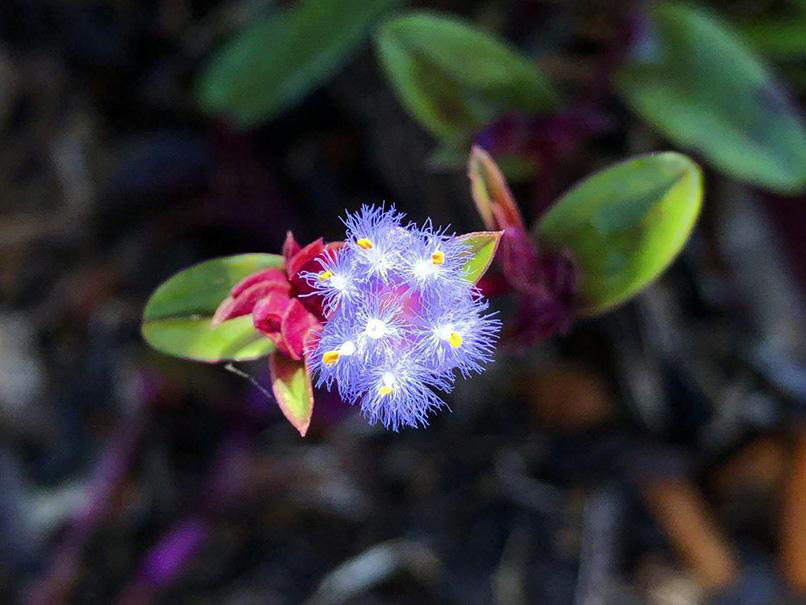
The to the top, more than 12,000 feet. Clumps of cushion plants and tiny windflowers. Among the most enchanting were orange and yellow Gentianella hirculus which resemble hot air balloons only half an inch tall. It was a subtle and engaging landscape that made us stoop to see the details.

Encinitas, CA. -- The feather duster palm, Rhopalostylis sapida, has the southernmost range of any
![]() |
| New Zealand native. |
palm, meandering to the South Island of New Zealand. It's swollen and distinctive crown shaft bulges beneath upright stiff fronds. It is a prize here at the San Diego Botanic Garden.
On 37 beautifully kept acres, the garden is in full bloom this spring. Coral trees and a daisy tree, kangaroo paws and Matilija poppies, bottlebrush trees and California poppies blend their brilliant colors with palms, cycads, succulents and bamboo. For a visiting Floridian, it is a new world of shapes and shades, of desert and original maritime chaparral, as well as succulents, iris and roses arranged in tapestries of great charm.
![]() |
| Puya alpestris, Chilean bromeliad. |
Some plants that caught my eye: a delicate, elegant pine-leaf bottlebrush, Callistemon pinifolius, from New South Wales; jewel-toned flowers of a Chilean bromeliad, Puya alpestris, that shine in teal and turquoise while flashing orange stamens; yellow bearded iris against blue-gray agaves and yellow roses; vegetable gardens planted in surprising containers (sugar cane sprouting from a giant sugar bowl and all the ingredients for salsa growing in an oversized salsa bowl), and hummingbirds aplenty.
Topographically the garden rises and falls over a hilly landscape. Great emphasis is placed on capturing the imagination of children with a tree house, an alphabet garden, interactive play areas where dinosaur eggs can be found and seeds planted. Succulents are displayed with great imagination, and pair well with cycads and roses.
![]() |
| Succulents create the dress and hat of this lady. . |
Donated to San Diego County by Ruth Larabee in 1957, the garden’s original name was Quail Botanical Gardens. Gil Voss, beginning in 1974, renovated the garden. Voss started the herbarium, plant records and mapped the garden. He co-founded the American Bamboo Society before retiring from the botanic garden in 1989.
The SDBG has an annual chocolate festival, gala, endangered species celebration, bromeliad show, and a lady bug day. An emphasis throughout the plantings is water conservation. There also is a demonstration of landscaping for fire prevention.
![]() |
| Flowers of the bromeliad Alcantarea imperialis finally opening. |
![]() |
| Codiaeum variegatum 'Polychrome'. |
Croton lovers gathered at Flamingo Gardens in Davie on Sunday, where executive director Stan Wood led them through the croton collection and then gave them a peek at a collection around his home in the back of the property. The Croton Society disbanded two years ago, but from time to time, loyalists will suggest touring a garden that features their favorite shrub.
Jeff Searle, of Searle Brothers Nursery in Southwest Ranches, not only loves palms but he’s also a croton fancier and a great auctioneer. Almost everyone who came to the croton tour -- and they came from St. Petersburg, Ft. Myers, Palm Beach County as well as the Florida Keys in addition to the Broward and Miami-Dade – brought crotons to sell. The same crowd bought all of the crotons auctioned.Highest price for the day was $127. Milky Way,
![]() |
| Orange and red predominate here. |
brought in $93. Some plants were give-aways at $1, $3 or $5, but most were bid up to $35 and $45. Oldies but goodies included William Craig, with predominantly orange coloration; Dr. Frank Brown; Prince of Orange, with orange and red markings over green and a red central vein; Irene Kingsley; General Marshall, Her Highness and William Craig.
Orange is color that appears in many new crotons (Codiaeum variegatum), but the delicate pinks, such as that found in Madam Butterfly and Helen Edge, are just as lovely. Searle declared that among the auction plants, a strap-leaf called Veitchii is one of the fastest growing and Claudia Lorraine is great for keeping its color in the shade.
In the Garden’s collection, croton scale is quite visibly affecting the plants. The scale is betrayed by
![]() |
| Croton scale. |
sooty mold, a mold that grows on the excrement of the insects. In addition to crotons, the scale, which arrived in the Keys in 2008, feeds on more than 50 plants: avocado, carambola, mango, fire bush, paradise tree, wild lime, Bahama coffee, Jamaica caper and many other trees and shrubs. (Prompting one croton lover to wonder why the name picks on crotons only.)
Stan Wood uses oil sprays to fight the scale. Also enlisted in the battle is the mealybug destroyer, a ladybug. The larvae look like giant white mealybugs with lots of legs; the adults are black ladybeetles with rust colored head shields. Mealybug destroyer can be ordered online. Its voracious appetite occurs in the larval and adult form. A predatory wasp also kills the scale. Horticultural oils, which must be applied three times, one week apart, also work.
![]() |
| Mealybug destroyer. |
What to avoid: neonictinoids, a class of systemic chemicals that readily kills bees. The chemical imidacloprid is one of these. On Monday, the European Commission imposed a temporary and partial ban on neonictinoids, saying this class of chemicals posed “an acute risk to honeybees.” The New York Times reported earlier this month that a coalition of beekeepers and environmental and consumer groups has sued the EPA for conditionally approving some of them.
From the Natural Resources Defence Council is this about pyrethroids:
Pyrethroids are toxic to humans and dogs, and they can be particularly lethal to cats, bees, and fish and other water-dwelling creatures. In humans, the chemicals can harm the nervous system, and high amounts can cause headache, difficulty breathing, nausea, and vomiting. The Environmental Protection Agency (EPA) has found that one member of the pyrethroid class, permethrin, is "likely to be carcinogenic to humans."
The chemicals kill insects by blocking the transmission of messages in the nervous system. The human nervous system is less susceptible to these chemicals both because of our larger size and because humans and many other mammals have detox mechanisms to help rid the body of these chemicals. However, recent studies indicate that prenatal and infant exposure may lead to cognitive and developmental problems later on. Although dogs are able to detoxify these chemicals, cats are more susceptible and can suffer tremors, twitching, convulsions, and death if owners misuse pyrethroid-containing products.
![]() |
| Feb. 27 bloom developing. |
Leaves began to arrange themselves in a tighter rosette at the end of January. By mid-February, the inflorescence began its ascent. This morning, bloom spike of Alcantarea imperialis has reached 5 feet. I have always admired its handsome demeanor. The specimen in my home garden is several years old, and resides in a container by the koi pond. The imperial bromeliad is positioned so it receives sun from mid-morning
![]() |
| March 23. |
to mid-afternoon, allowing the wine and blue-gray foliage colors to deepen. I have not fertilized it in a long time because its lower leaves form a skirt around the container. Because of its size, it stays outside during cold spells, and apparently it has relished its spot, although it may be warmer near the pond when cold arrives. In
![]() |
| April 25. |
Brazil, is grows on cliffs near Rio de Janiero, but in small numbers these days. Roberto Burle Marx, Brazil’s artist and landscape designer who died in the late 1990s, used A. imperialis often in his landscapes, and his American admirer, landscape architect Raymond Jungles, has included it in a number of his own gardens.
The flowers are just beginning to stick their noses from within the floral bract, so when the final extravaganza occurs, I will post another photo.
![]() |
| A Jack-and-the-Beanstalk flower stalk. |
![]() |
| Catalina Madrinan shows BambooCo Cycle that will aid a community in an area of Cali, Colombia. . |
At the Food and Garden fest Saturday morning, Catalina Madrinan was still furnishing her booth when we wandered over to talk. Worm castings and worm tea, a calendar called Ladies of Manure and a few small plants were her tabletop display, but the really attractive bamboo bicycle was a prize. It was the first one finished in a program that Cata and her friend Sonia Quintero have started in the Montebello neighborhood of Cali, Colombia to train community members to build the frames and generate income for the densely populated neighborhood. Ecocultura, the women’s company, held a contest to name the bike frame and the winner was BambooCo Cycle. The frame now sells for $600 because it takes a week to make, Catalina said. I signed up to receive updates on the project.
![]() |
| Ladybug swing made of old tire. |
Over at the Re-tired Tire booth, ladybug tires suitable for swings, black and white chicken planters and tread-y alligators are delightfully clever uses for something we have too many of, used tires.
![]() |
| Spring plant sales drew many buyers. |
Leila Warner, who works at the Fairchild Farm, was at the fruit pavilion, where displays included beautiful baskets of papaya, canistel, mangos and vanilla orchid cuttings, honey and Everglades tomatoes. Leila reports that she went camping at Myakka State Park recently and came up with the idea of how to start a charcoal fire using a homemade candle. She gathered a lot of oak twigs and melted candle wax over them in a small container. These can be used in the center of briquettes to avoid that awful smell of lighting fluid.
Sales of Fairchild’s nursery-grown plants were brisk, and lots of people seemed to be refurbishing their butterfly gardens with plants Mary Collins readied, including two kinds of native passionflower, moujean tea, a dwarf shrub from the Bahamas, Croton linearis, a host for two rare butterflies, Bartram’s’ Hairstreak and Florida Leafwing.
Plenty of vegetable and flower garden-y things to buy, from miracle fruit to 15-foot fruit pickers. There are talks and demonstrations scheduled throughout today and Sunday.
![]() |
| Neoregelia 'Invincible'. |
Rows of perfectly grown bromeliads are displayed in the Garden House as the annual show and sale of the Bromeliad Society of South Florida opens this weekend. Judging was Friday, and I was there just after ribbon judging; major awards were still to be decided. But from the awards of merit on display, from which the major awards are determined, it was not to be an easy task. The correct conformation and color are two criteria that the judges consider. Neoregelia hybrids are exceptionally popular now
![]() |
| An intergeneric hybrid, x Neomea. |
because of their wow-power, but you may also be taken by the perfect symmetry of Quesnelia marmorata ‘Tim Plowman’ and the raspberry infusion of color in Billbergia ‘After Glow’ or the glorious orange or red inflorescences of Guzmania hybrids. If you want to know the secrets to growing some of these beauties, the experts will be on hand, so don’t be afraid to ask.
![]() |
| Kaempferia rotunda, or Indian crocus. |
Walking up the mulched path this week, three of us discovered lavender/purple flowers that looked as if they had fallen from above and landed gently in the leaves. But overhead, there was no flowering vine or tree, so we went closer.
The cluster of flowers arose from the soil, and the nametag told us it was Kaempferia rotunda. Dormant over winter, like other Kaempferia species, this plant is from China, Bangladesh, India, Myanmar and surrounding countries in south Asia. Patterned leaves will emerge after the flowers disappear, growing from an underground stem or rhizome. Kaempferias are in the ginger family.
Missouri Botanical Garden describes the complex flowers this way: “Each flower has purple-brown bracts at the base inside which the three-parted white calyx … can be seen. The petals are also white and they are fused at the base into a tube with widely spreading linear lobes (5.0 cm long). The purple petal-like structures are produced from the fusion of five sterile stamens (pollen producing structures) that are divided into two lobes that are 3.5 cm long and 2 cm long.”
There are several additional species and cultivars, including ‘Satin Cheeks’, planted in Plots 26, 27 and 28 near the shaving brush and floss silk trees, so watch for them as spring continues.
![]() |
| Agnes Nyanhongo with one of her elegant stone women. |
Agnes Nyanhongo, whose work is among the figures in Custom and Legend, a Culture in Stone on display in the lowlands, joined several of us for lunch this week, at the invitation of Eleanor Lahn, a long-time Fairchild volunteer. One of Zimbabwe’s most important artists, Agnes said with an easy smile that she began to sculpt at age 12, learning from her famous father, Claud. She is one of 19 children – there are two mothers and one sibling has died – and her artist family is famous for their sculpture. She went to art school, but picked up the chisel and answered the call of her original impulse in 1980.
Agnes talked about how she allows the stone to tell her what it wants to be, and how it may change as she works, even though her themes are consistent. Roy Guthrie, who for 30 years has championed the African sculptors from his native country through exhibitions and even by supplying their tools and stone, said of the piece Agnes currently is working on – Woman with an Open Heart -- that “she looked at the stone for two days before even touching it.” Then she decided on the base, and simply watched it for another two days.
Concentrating on women’s roles in family and society, her marvelous pieces express a radiant dignity. Woman of Authority, one of her works memorializing a Zimbabwe heroine who died in the fight for independence, stands near a more personal piece, showing her grandmother carrying water. “She lived to 105,” Agnes said, “and always did the work by herself so she could be part of the family, not just an elderly woman cast aside.” The Chapungu tradition, begun 50 years ago, is to use only hand tools even when polishing portions of the stone that so beautifully contrast with rough unworked surfaces. Agnes said she does the polishing by hand, using finer and finer sandpaper, and then applies bees’ wax to allow the wax to be absorbed into the stone. Finally, she said, the area is buffed to its fine finish.
The exhibit has taken Agnes to gardens around the United States, but usually in the summer, she said, from July through September, and then she returns home. The pieces have been displayed at Kirstenbosch Gardens in Cape Town, South Africa, the Royal Botanic Gardens, Kew, and throughout Germany. A permanent outdoor exhibit of 82 Chapungu works is displayed in Loveland, Colorado.
A pair of enormous Aechmea bromeliads has inhabited my garden for years, moving into various settings as they grew in size. The last time I moved them, I said that was it; they were too big and too dangerously armed to move again. They lived behind a group of shell ginger for a few more years, until I decided to cut away the gingers to allow more air into an orchid house.
![]() |
| Aechmea mariae-reginae. |
Eliminating the gingers opened up a commodious spot where Anthurium x Marie could display her girth – she is seven feet across in an oversized container. Alas, this happened to be beneath a queen palm and Poinciana tree, and soon Marie was bruised and unhappy. So today, she found a new home, and upon wrestling Marie from beneath the offending litter-droppers, I made a new discovery: the bromeliads are Aechmea mariae-reginae, Queen Mary bromeliad. The species is from Costa Rica and Nicaragua, and it requires many years to flower. One of my pair is in flower. The flower spike, with hot pink bracts, has dozens of individual flowers that develop blue tips and then fade to pink as they expire. The plants are full sun bromeliads, but they lived for a long time in shade, no doubt accounting for four-foot leaves shooting out in a rosette. A. mariae-reginae is one of the rare bromeliads that is dioecious, with male and female flowers on separate plants. The shape of the open inflorescence is female-like. We’ll see if there’s a male when the second one flowers. After these bromeliads flower they will die. I'm hoping for pups.