The art of Claude and Francois-Xavier Lalanne was at Fairchild during the 2010-2011 art season. Their art is inspired by nature itself as Claude Lalanne typically used plant forms in her work and her husband Francois-Xavier used animal forms.
![]() |
| Claude Lalanne's, Dimetrodon II, 1998 |
![]() |
| Claude and Francois-Xavier Lalanne's, Moutons Transhumant (Bebris), 1998 |
|
|
||||
|
|
||||
|
|
||||
|
|
||||
|
|
Singe Avisé (Très Grand), 2008, Francois-Xavier Lalanne
This regal monkey was Francois-Xavier Lalanne’s last completed sculpture. Sitting six and a half feet tall, the creature is cross-legged, with a pensive expression.
Moutons Transhumant (Bebris), 1988, Claude & Francois-Xavier Lalanne
Moutons, a herd of 12 sheep and lambs, was first created in 1965, with several updated editions since. The work was created to be something “invasive and out of the ordinary,” meant to mock what is traditionally viewed as “fine art.” Placement in the Palmetum evokes a peaceful, pastoral setting.
Dimetrodon II, 1998, Claude and Francois-Xavier Lalanne
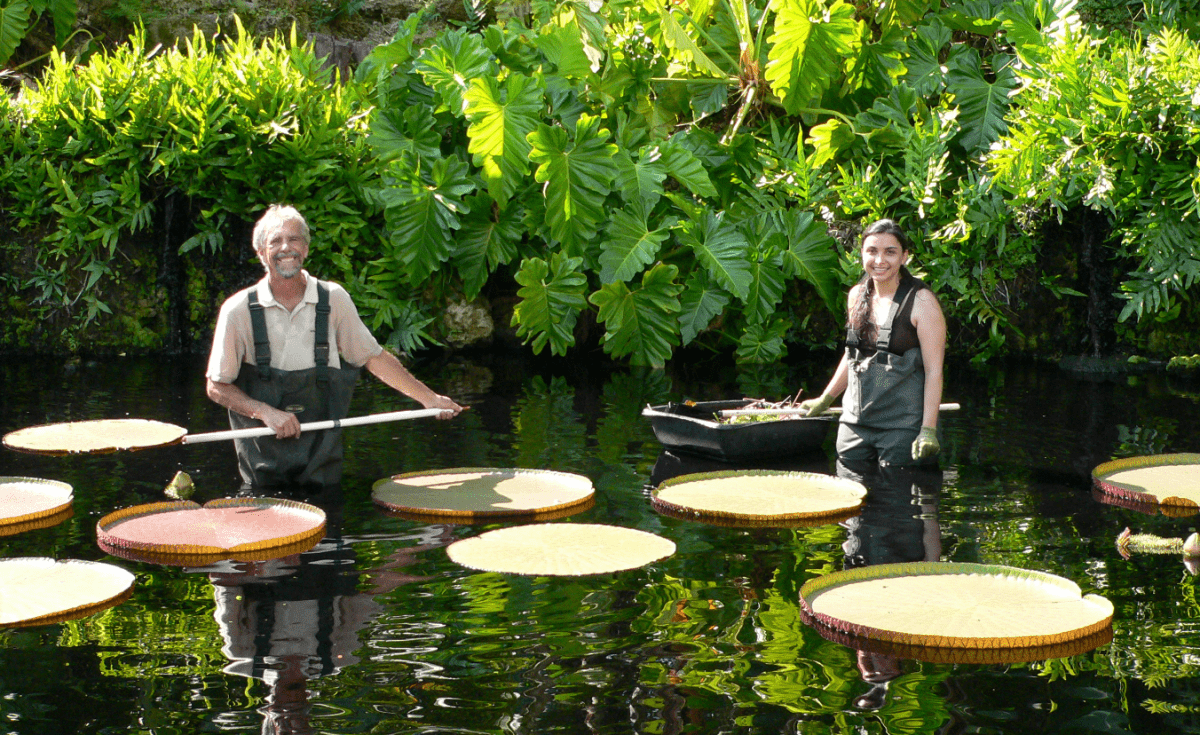
Dimetrodon II, a topiary sculpture, will keep predators away from the Victoria amazonica Pool. Framed by stainless steel with a copper fin and covered in live plant material, water spout’s from this fictitious dinosaur’s mouth.
Requin (Grand), 2006, Francois-Xavier Lalanne
This stylized shark form is no stranger to Fairchild, having been exhibited here once before, during the 2006-2007 Art at Fairchild program. Requin (Moyen) is five feet, eight inches long and made of a combination of bronze and manganese, creating a “sparkling” effect on the shark’s skin.
Canard Sur L’Eau, (Grand Canard flottant), 2006 , Francois-Xavier Lalanne
Canard sur L’Eau is a five foot high, six foot long duck figure featuring a rotating head and back that lifts upward towards the sky.
Genie de Bellerive (Grand) Sur pylone, 2007, Francois-Xavier Lalanne
Genie de Bellerive Grand Noir is a bronze sculpture of a young owl perched atop a pedestal. The owl’s stance, with its wings spread wide, is a tribute to the Lalanne’s neighbor and friend, German artist Max Ernst, whose fascination with birds was a frequent theme in his own work. Additionally, the owl’s position on top of an “Endless Column” is an homage to Romanian sculptor Constantin Bancusi’s famed piece of the same name.
La Grand Ourse, 1994, Francois-Xavier Lalanne
Grand Ours is a large bear figure, standing upright at ten feet tall. The bear’s smooth finish and rounded form offsets his imposing size.
Poison Paysage V, 2006, Francois-Xavier Lalanne
Vache Paysage is a four foot high, seven foot long cow with a “window” cut out of the majority of its body. Vache Paysage is placed in the pastoral setting of the lawn near Cycad Circle, viewing the Bailey Palm Glade vista. Its previous homes include The Duke of Devonshire’s (and current vice President of Sotheby’s auction house) estate.
Oiseau de nuit (Grand), 2004, Francois-Xavier Lalanne
The owl, a universal symbol of wisdom, sits atop a pedestal in this six foot tall bronze sculpture. Oiseau de Nuit (Grand) features a smooth finish and rounded form, punctuated by extremely life-like claws.
Wapiti (Grand), 1996, Francois-Xavier Lalanne
This patinated bronze sculpture depicting a North American elk stands nearly eight feet tall and five feet long. The elk’s stance, which features an over the shoulder gaze, serves to urge the audience to consider the animal’s perspective.
Olympe (Grande), 2001, Claude Lalanne
This 2001 sculpture by Claude Lalanne, modeled after her own granddaughter, features a young girl posed in the stance of a Greek athlete holding the Olympic torch. Cast lettuce leaves are draped as a mantle on the girl’s shoulders, and water sprays triumphantly from her right hand. Les Lalanne at Fairchild marks Grand Olympe’s United States debut.
Pomme d’Hiver, 2008, Claude Lalanne
Pomme d’Hiver is Claude Lalanne’s 2008 sculpture of a winter apple. This piece reaches seven feet tall at the top of its stem, and is being shown in the United States for the first time as part of Les Lalanne at Fairchild.
Choupatte (Très Grand), 2008, Claude Lalanne
Claude Lalanne’s 2001 sculpture is also referred to as “cabbagelegs” because of the work’s resemblance to a head of cabbage with bird’s feet. A variation of her first sculpture, Choupatte (Trés Grand) is textured and colored by verdigris, a green pigment obtained when acetic acid is applied to copper. It has been said that the cabbage is to Mrs. Lalanne what the acanthus leaf was to Greek artists.
Nouveau Lapin de Victoire (Grand), 2010, Claude Lalanne
Created especially for Fairchild by Claude Lalanne recently, this seven foot tall rabbit sculpture stands upright with his stately cane and is sculpted entirely out of bronze.
Poisson Paysage V, 2007, Francois-Xavier Lalanne
Claude Lalanne’s bronze fish is sculpted with its middle squarely cut out, serving as a splendid frame for the ever changing natural beauty of Fairchild.
Lievre de Maillac I (Fontaine), 1998, Francois-Xavier Lalanne
Franciose-Xavier Lalanne’s series of four small, seated rabbits are made of bronze and double as fountains.
Crocodile (Banc), 2010, Claude Lalanne
Claude Lalanne is known for working with plants in her sculptures, while Francois-Xavier is known for depicting animals in his works. In this playful table, Mrs. Lalanne proves that while their styles were distinct, they husband and wife team clearly influenced each other.

Claude Lalanne (b. 1924) was born in Paris and studied architecture at the Ecole des Beaux-Arts and at the Ecole des Arts Décoratifs. François-Xavier (1927-2008) was born in Agen and studied painting at the Julian Academy in Paris. His first painting exhibition was in 1952 and in 1956 he began creating sculptures with his wife Claude. Known collectively as Les Lalanne, they developed a style that defines inventive, poetic and surrealist sculpture.
Although the two artists collaborated for decades, Claude and François-Xavier Lalanne offer separate bodies of work that differ conceptually and aesthetically. Claude Lalanne’s work relies on natural forms, typically animals and plants, often forming airy, sculptural furniture whose vine-like curvatures enmesh animal and plant fragments. Having rediscovered the Renaissance art of casting forms from life, her work uses an electro-plating technique to create bronze sculptures that seem to freeze nature. Claude’s signature is the resulting delicacy and organic sensitivity of her sculpture.
François-Xavier also found inspiration in nature, as, in his words, "the animal world constitutes the richest and most varied forms on the planet." His work consist of architectural, solid, bronze structures, that achieve a playful elegance with profound simplicity.
Most recently, Les Lalanne were the subject of a major retrospective at Les Arts Décoratifs in Paris. Their work was also featured on New York’s Park Avenue and in the sale of the collection of Yves Saint Laurent. Their work is included in major collections including the Cooper Hewitt Museum in New York, the Museé Nationale d’Art Moderne/Centre Georges Pompidou, the Museé d’Histouire Naturelle in Paris, the City of Paris, the City of Santa Monica, and the City of Jerusalem.
Art at Fairchild is generously supported by The John S. and James L. Knight Foundation, Lin Lougheed and Aaron I. Fleischman.