The Occasional Papers of Fairchild Tropical Garden, 1938-1950 |
||
|
|
|
|
|
Adonidia merrillii (Becc.) Becc. (Arecaceae). The discoverer of the Maya palm, Dr. O. F. Cook, examining five of his palms grown from seed collected in March 1922 near Uaxactun, Guatemala. They are fifteen years old and have sent out their first flower clusters but the blooms have not yet opened. Shaded by stone walls they show their suitability for small gardens or dooryards in Florida. Photograph taken in Chapman Field Plant Introduction Garden, 1937. See Occasional Paper No. 1, p. 8. |
Adonidia merrillii growing at Fairchild Tropical Botanic Garden, plot 142. Photograph taken by Mary Collins, FTBG, February, 2013 |
Jaboticaba [Myrciaria cauliflora (Mart.) O. Berg (Myrtaceae)]. "The handful of Jaboticaba fruits which Mrs. Krome brought me from the de Haven tree in Winter Haven. These were not so large as some that Mr. de Haven sent me later but they had the same delicate grape-like flavor which I found delicious. The fruit pulp is so brilliantly white that it was difficult to photograph." See Occasional Paper No. 2, p. 3. |
Before there was a building, a museum, a garden publication or even very many new plants at Fairchild Tropical Botanic Garden, there was a series of papers meant to introduce to the members of the Garden new plants with high ornamental and edible potential that could be easily cultivated in South Florida.
Both Robert Montgomery and David Fairchild saw immediately that the biggest need for members of the Garden was not for a place of entertainment, but a site to learn about the “strange” new sub-tropical world in which they were living. Most people then (and perhaps even now) had moved to south Florida from more temperate areas. They had no experience with their new tropical home, and almost no resources to find out how to make their landscapes attractive and healthy. Most people soon learned that introduced temperate zone plants, and even those growing in central and northern Florida, were doomed to die or to languish here. In addition, there were few places they could turn to for advice on what to plant.
To help solve this need the Occasional Papers were born. Wisely not committing himself to a regular schedule, David Fairchild promised them only occasionally. He was, after all, already 69 years old. Both he and Robert Montgomery envisioned the Occasional Papers as a way to inform Garden members about the details of growing, and the stories behind, the new plants coming into the area – mostly from the Garden’s plant hunting expeditions.
The Occasional Papers stood as the Garden’s only official serial publication for the first seven years of the Garden. It wasn’t until 1945 that the first issue of the Bulletin of the Fairchild Tropical Garden was issued. It included a note to those members who had received any of the first ten Occasional Papers to return them if they did not want them. Although 500 of each had been printed, they were out of print and other new members were asking for copies. Apparently, this demand continues today as copies are occasionally offered for sale on auction and second hand bookseller web sites.
In all, 19 Occasional Papers were published from 1938-1950. David Fairchild wrote all but two of them. The majority of them are about specific plants, with the exception of Nos. 8, 9, and 10. These include descriptions of dozens of plants from the Cheng Ho Expedition. A list of the issues (with website links to download them) is included below.
The specific plants featured in the 19 Occasional Papers are also listed below, along with the current names, nicknames, and plot locations within Fairchild Tropical Botanic Garden as of Spring 2013. As one of David Fairchild’s goals was to feature plants he thought could be successfully grown in south Florida, the notes include a brief assessment of their current popularity.
| Current determination and accepted name |
Name used by David Fairchild |
Common name | Occasional paper number | Type of plant |
At FTBG?* | |
| Adonidia merrillii (Becc.) Becc. (Arecaceae) |
Adonidia merrillii | Christmas palm, Manila palm |
1 | palm | Yes | |
|
iii |
||||||
|
Antidesma montanum Blume var. montanum (Phyllanthaceae) |
Antidesma nitidum Tul. |
antidesma | 6 | fruit tree | The Farm | |
|
iii |
||||||
| Artocarpus heterophyllus Lam. (Moraceae) | Artocarpus integra (Thunb.) Merr. | jack fruit | 16 | fruit tree | Yes & The Farm | |
| iii Note: Enormous fruit; good as dried fruit. iii |
||||||
| Borassus flabellifer L. (Arecaceae) | Borassus flabellifer | palmyra palm | 15 | palm | Yes | |
| iii Note: Big, beautiful palm. It is grown by palm enthusiasts. iii |
||||||
|
Casimiroa edulis La Llave (Rutaceae) |
Casimiroa edulis |
white sapote | 5 | fruit tree | Yes | |
| iii Note: Can be grown as backyard tree; usually eaten fresh or in smoothies and other desserts. iii |
||||||
|
Casimiroa tetrameria Millsp. |
Casimiroa tetrameria | matasano, white sapote |
5 | fruit tree | No | |
| iii Note: Can be grown as backyard tree; similar to C. edulis but less popular. iii |
||||||
| Chamaedorea pinnatifrons (Jacq.) Oerst. (Arecaceae) | Chamaedorea pacaya Oerst. | 1 | palm | Yes | ||
| iii Note: Easy to grow, but still seldom seen in nursury trade. iii |
||||||
|
Clausena lansium (Lour.) Skeels (Rutaceae) |
Clausena lansium | wampee, wampi | 19 | fruit tree | No | |
| iii Note: The Kampong's wampee still remains a signature tree but the fruits have not gained popularity in South Florida. iii |
||||||
|
Cocos nucifera L. |
Cocos nucifera | coconut | 17 | palm | Yes | |
| iii Note: The well known cconut tree is very popular, but susceptible to Lethal Yellowing disease. iii |
||||||
| Combretum grandiflorum G. Don (Combretaceae) | Combretum grandiflorum | showy combretum | 3 | vine | No | |
| iii Note: A beautiful vine. At one time FTBG had 4 plants collected by David Fairchild. iii |
||||||
|
Gaussia maya (O.F.Cook) H.J.Quero & Read (Arecaceae) |
Opsiandra maya O.F. Cook (Arecaceae) | Maya palm | 1 | palm | Yes | |
| iii Note: Tends to be weakly rooted and as a result, plants often fall over. Due to the habit of leaning or falling over, it is not commonly available. iiii |
||||||
| Hernandia nymphaeifolia (J.Presl) Kubitzki (Hernandiaceae) | Hernandia ovigera L. | 4 | ornamental tree | No | ||
| iii Note: Our David Fairchild collected trees all died due to cold. Some available from nurseries. iii |
||||||
|
Myrciaria cauliflora (Mart.) O. Berg (Myrtaceae) |
Myrciaria cauliflora | jaboticaba | 2 | fruit tree | Yes | |
| iii Note: Popular tropical fruit, requires acid soil when young. iii |
||||||
|
Pouteria campechiana |
Lucuma nervosa A. DC. (Sapotaceae) | canistel | 13 | fruit tree | The Farm | |
| iii Note: Locally popular; fruit used in cooking. iii |
||||||
|
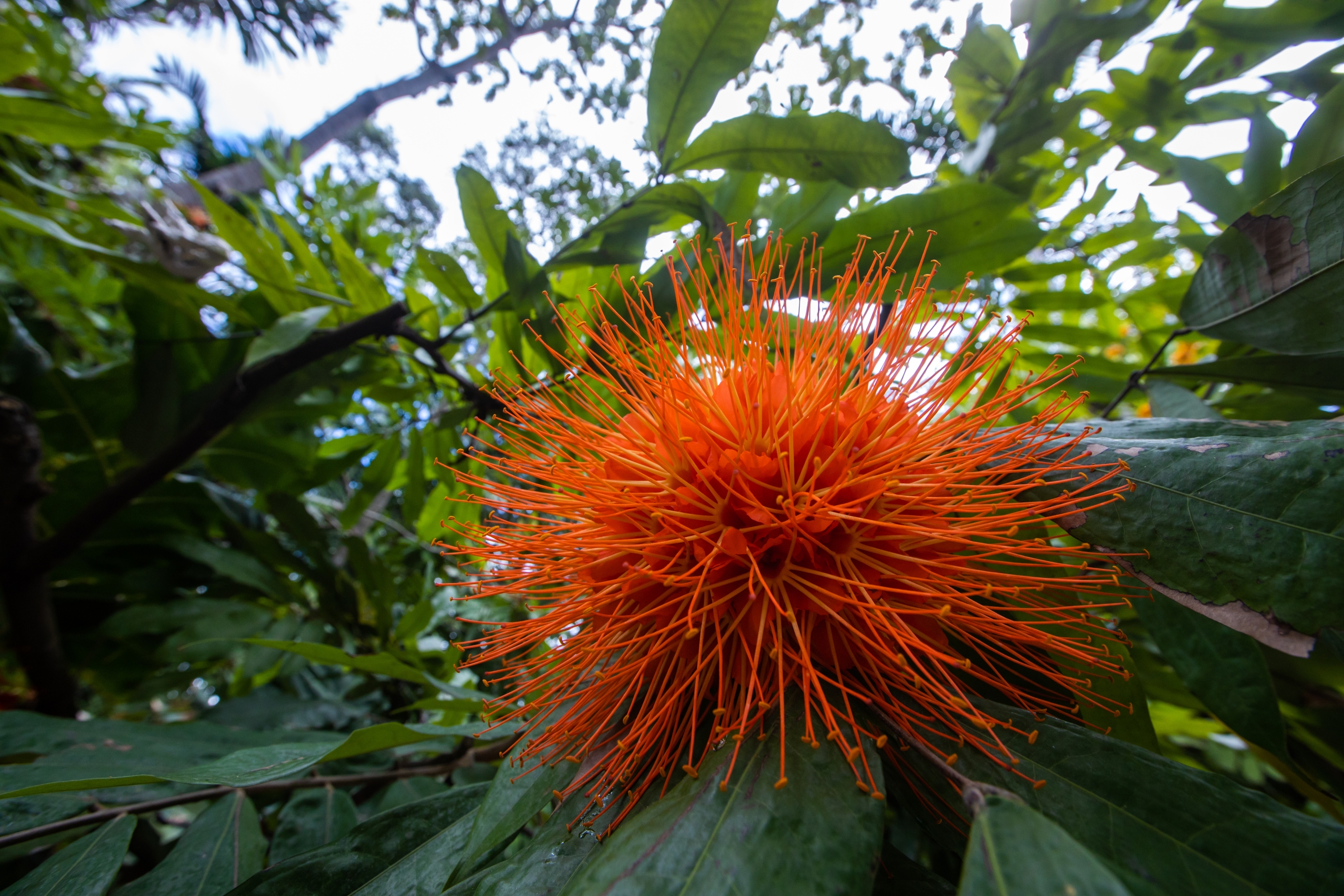
Pseudobombax ellipticum (Kunth) Dugand (Malvaceae) |
Pachira fastuosa Decne. (Malvaceae) | shaving-brush tree |
11 | ornamental tree | Yes | |
| iii Note: Large tree with very showy blooms. Still seen in many Miami neighborhoods but less popular now. iii |
||||||
|
Ptychosperma elegans (R. Br.) Blume (Arecaceae) |
Ptychosperma elegans | solitaire palm | 7 | palm | no | |
| iii Note: A very popular palm in the landscape industry. iii |
||||||
|
Ptychosperma macarthurii |
Actinophloeus macarthurii (H. J. Veitch) Raderm. (Arecaceae) |
MacArthur palm |
7 | palm | no | |
| iii Note: A very popular palm in the landscape industry. iii |
||||||
|
Rhapis excelsa Thunb. Henry (Arecaceae) |
Rhapis excelsa | lady palms | 7 | palm | no | |
| iii Note: This has become very popular in the landscaping and interiorscaping business. iii |
||||||
|
Rhapis humilis Blume |
Rhapis humilis | slender lady palm | 7 | palm | no | |
| iii Note: Lesser known than R. excelsa. iii |
||||||
|
Sterculia foetida L. (Sterculiaceae) |
Sterculia foetida | Indian almond |
12 | ornamental tree | Yes | |
| iii Note: Flowers have a very strong, bad odor; not common in the nursery trade. iii |
||||||
|
Thysanolaena latifolia (Hornem.) Honda (Poaceae) |
Thysanolaena agrostis Nees | tiger grass | 14 | grass | **Yes | |
| iii Note: Available in a few nurseries, used in some landscapes. iii |
||||||
| * Not necessarily plants personally collected by David Fairchild. | ||||||
| ** From this list, this is the only collection by David Fairchild still growing at Fairchild Tropical Botanic Garden. | ||||||
Fairchild, David & Robert Montgomery. Florida Plant Immigrants; illustrating and describing new or rare plants that have been introduced into Florida in recent years together with suggestions regarding their uses and species deemed worth introducing. Occasional Paper Introduction, 1938.
Fairchild, David. Three attractive slender palms for South Florida. Florida Plant Immigrants, Occasional Paper No.1. September 1, 1938.
Fairchild, David. The Jaboticaba “The Grape of Brazil”. Florida Plant Immigrants, Occasional Paper No. 2. January 1, 1939.
Fairchild, David. A Gorgeous vine from West Africa. Hernandia ovigera a handsome strand tree from Sumatra. Florida Plant Immigrants, Occasional Paper No. 3 & 4. March 31, 1939.
Fairchild, David. White Sapote and the Matasano. Antidesmas as promising fruit trees for Florida. Florida Plant Immigrants, Occasional Paper No. 5 & 6. October 1, 1939.
Bailey, L. H. Rib-seed palms in Florida, the lady palms. Florida Plant Immigrants, Occasional Paper No. 7. January 1, 1940.
Fairchild, David. Letters from the Philippines. Florida Plant Immigrants, Occasional Paper No. 8. April 1, 1940.
Fairchild, David. Expedition to the Philippines and Netherlands India. Florida Plant Immigrants, Occasional Paper No. 9. February 1, 1941.
Fairchild, David. More plants from the Fairchild Garden Expedition to the Philippines and Netherlands India. Florida Plant Immigrants, Occasional Paper No. 10. February 5, 1942.
Fairchild, David. Pachira fastuosa; a tree that is famous for its smell. The canistel. The tiger grass. Florida Plant Immigrants, Occasional Paper No. 11, 12, 13 & 14. March 16, 1943.
Fairchild, David. Introduction of the Borassus palms into Florida. Florida Plant Immigrants, Occasional Paper No. 15. May 15, 1945.
Fairchild, David. Jack fruit (Artocarpus integra, Merrill); its planting in Coconut Grove, Florida. Florida Plant Immigrants, Occasional Paper No. 16. May 10, 1946.
Fairchild, David. The Makapuno coconut of the Philippines: the story of the coconut that bears it and its introduction into Florida. Florida Plant Immigrants, Occasional Paper No. 17. August 30, 1947.
Fairchild, David, et. al. Ceremonies… in connection with the first awards of the Thomas Barbour Medal for distinguished service in the preservation of that vanishing eden, South Florida. at the Museum, January 11, 1948. Florida Plant Immigrants, Occasional Paper No. 18. January 11, 1948.
Fairchild, David. Wampee, a fruit tree of the far east. Florida Plant Immigrants, Occasional Paper No. 19, March 1, 1950.